
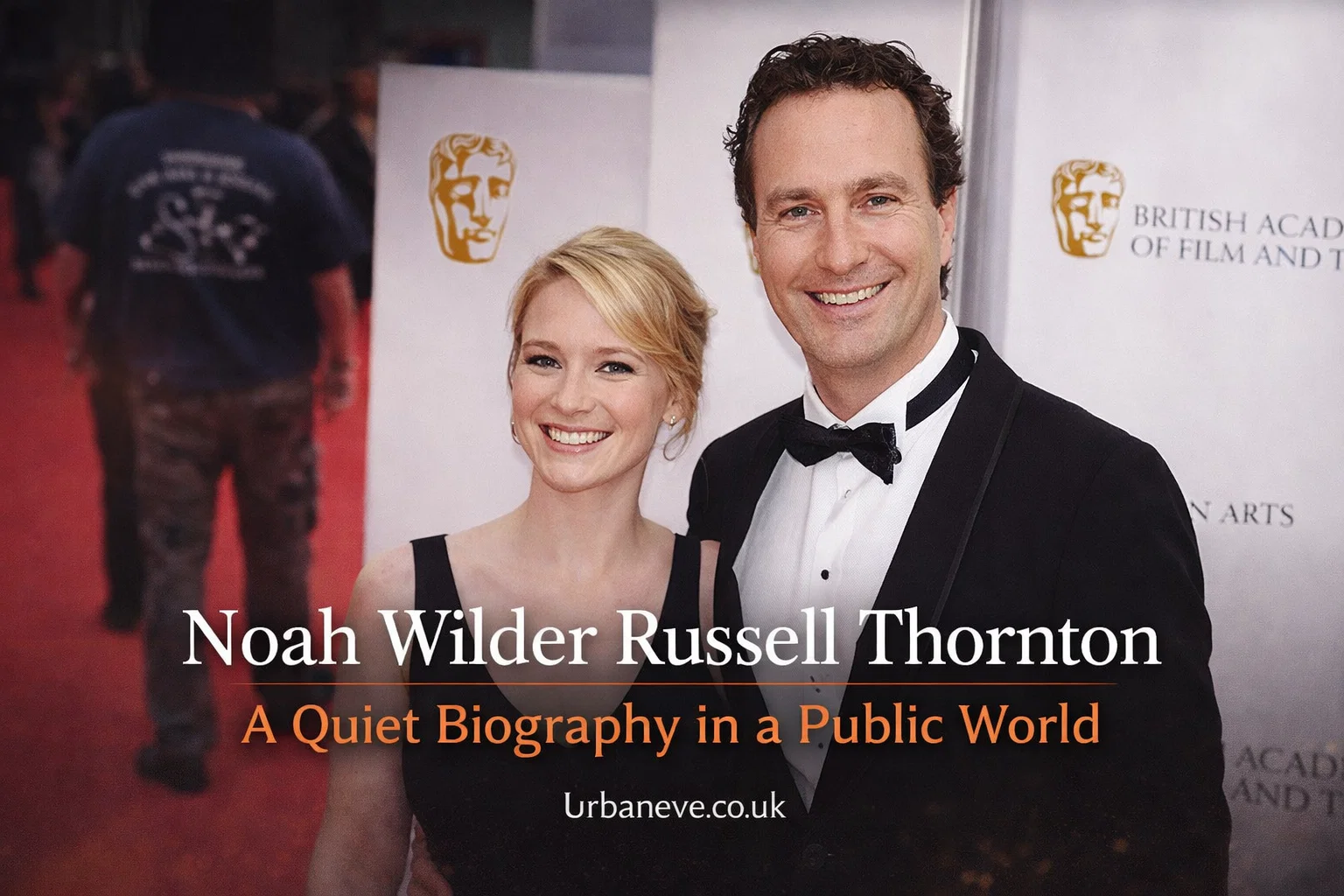
In an era when nearly every name can be searched, indexed, and republished within seconds, some biographies exist more in the space between what is known and what is deliberately left private. The name Noah Wilder Russell Thorton belongs to that category. It appears online with growing frequency, yet the verifiable details surrounding it remain intentionally limited. This contrast has made the name a subject of curiosity, discussion, and, at times, confusion.
What follows is a careful biography-style account written with restraint. It focuses on confirmed information, cultural context, and the broader meaning of growing up connected to public life, without crossing into speculation or intrusion.
Early Life and Family Background
Noah Wilder Russell Thorton was born in December 2016. His birth was publicly acknowledged by his parents, British actors Joanna Page and James Thornton, who shared the announcement through media interviews and social platforms at the time. The announcement confirmed his name and arrival but revealed little beyond that, a choice that has shaped how his life has been presented to the public ever since.
His mother, Joanna Page, is widely recognized for her work in British television, most notably for her role in the long-running sitcom Gavin & Stacey. Her career spans comedy, drama, and voice acting, earning her a steady presence in UK popular culture. His father, James Thornton, is also an actor, known for roles in television and film as well as for his work behind the scenes in writing and production.
Together, Page and Thornton have been open about the joys of parenthood while remaining protective of their children’s personal lives. Noah is part of a family that values normalcy despite public recognition, and this philosophy has informed how much of his story is shared.
The Meaning Behind the Name
The name Noah Wilder Russell Thorton carries a sense of individuality and tradition. Noah, a name with ancient roots, has remained consistently popular across cultures, often associated with resilience and continuity. Wilder adds a creative, free-spirited tone, suggesting imagination and openness, while Russell introduces a more classic family dimension. The surname Thorton, more commonly spelled Thornton in official records, reflects his father’s family name, though spelling variations online have contributed to search confusion.
Names often become symbols, especially when attached to families in the public eye. In this case, the combination has become distinctive enough to attract attention while still representing a private family choice rather than a public statement.
Growing Up Adjacent to Fame
From the moment his name entered the public domain, Noah’s life has existed at the edge of celebrity culture rather than at its center. Unlike child actors or public figures by choice, he has not appeared in performances, interviews, or official media projects. His visibility comes solely from association, not participation.
This form of indirect fame has become increasingly common. Children of public figures are often known by name long before they have any agency over their public identity. For families like the Thorntons, this reality requires constant balance. Public acknowledgment is sometimes unavoidable, but ongoing exposure is not.
In interviews over the years, both parents have expressed appreciation for family life away from cameras. That perspective has helped ensure that Noah’s childhood unfolds largely outside the spotlight, allowing personal development without the pressures that often accompany early attention.
Privacy as a Deliberate Choice
One of the most defining aspects of Noah Wilder Russell Thorton’s biography is not what is known, but what is not. There are no official public records detailing his education, hobbies, or daily life. This absence is intentional and increasingly respected in modern media ethics.
As conversations around children’s digital footprints have grown more serious, many public figures have chosen to limit how much they share about their families. The long-term implications of early exposure are better understood today than they were a decade ago. By keeping details private, parents retain control over how and when their children choose to engage with public attention later in life.
For Noah, this approach means that his biography remains open-ended. It is not defined by achievements, controversies, or public narratives, but by the simple fact of being allowed to grow without pre-written expectations.
Online Interest and Search Visibility
The rise in searches for Noah Wilder Russell Thorton says as much about the internet as it does about the individual. Search engines often amplify specific names once a threshold of curiosity is reached. Spelling variations, repeated references, and recycled content can give the impression of significance even when new information is scarce.
This phenomenon has created a digital echo around his name. Many online pages repeat the same foundational facts, often expanding them with generalized statements rather than verified updates. As a result, the name circulates widely while the actual biography remains brief and factual.
Such patterns highlight the difference between genuine public relevance and algorithmic momentum. In this case, the latter plays a significant role in why the name continues to appear across platforms.
A Childhood Outside the Narrative
While public biographies often follow a predictable arc of milestones and achievements, Noah’s story currently resists that structure. There are no career paths to analyze or public appearances to interpret. Instead, his biography reflects a childhood unfolding privately, shaped by family rather than audience.
This absence of narrative is not a limitation. On the contrary, it preserves possibility. Without external labeling, expectations remain flexible. Whether Noah eventually chooses a public-facing career or a private one will be his decision, made with the benefit of time and autonomy.
The Broader Cultural Context
The interest surrounding Noah Wilder Russell Thorton fits into a larger cultural moment. Society is reassessing how it treats children connected to fame. The shift is subtle but meaningful, moving from curiosity-driven exposure toward consent-based visibility.
Media outlets increasingly acknowledge the distinction between adult public figures and their children. Readers, too, are becoming more aware of the long-term consequences of early digital presence. In that environment, a restrained biography is not a lack of information, but a reflection of evolving standards.
Conclusion
The biography of Noah Wilder Russell Thorton is, by design, a quiet one. It confirms his place within a well-known family while honoring the boundaries set around his personal life. Rather than a story of achievements or public milestones, it is a record of protected beginnings.
In a world where attention often arrives before consent, this kind of biography offers a different model. It suggests that significance does not always require visibility and that some lives are best understood not by what is shared, but by what is thoughtfully withheld.