
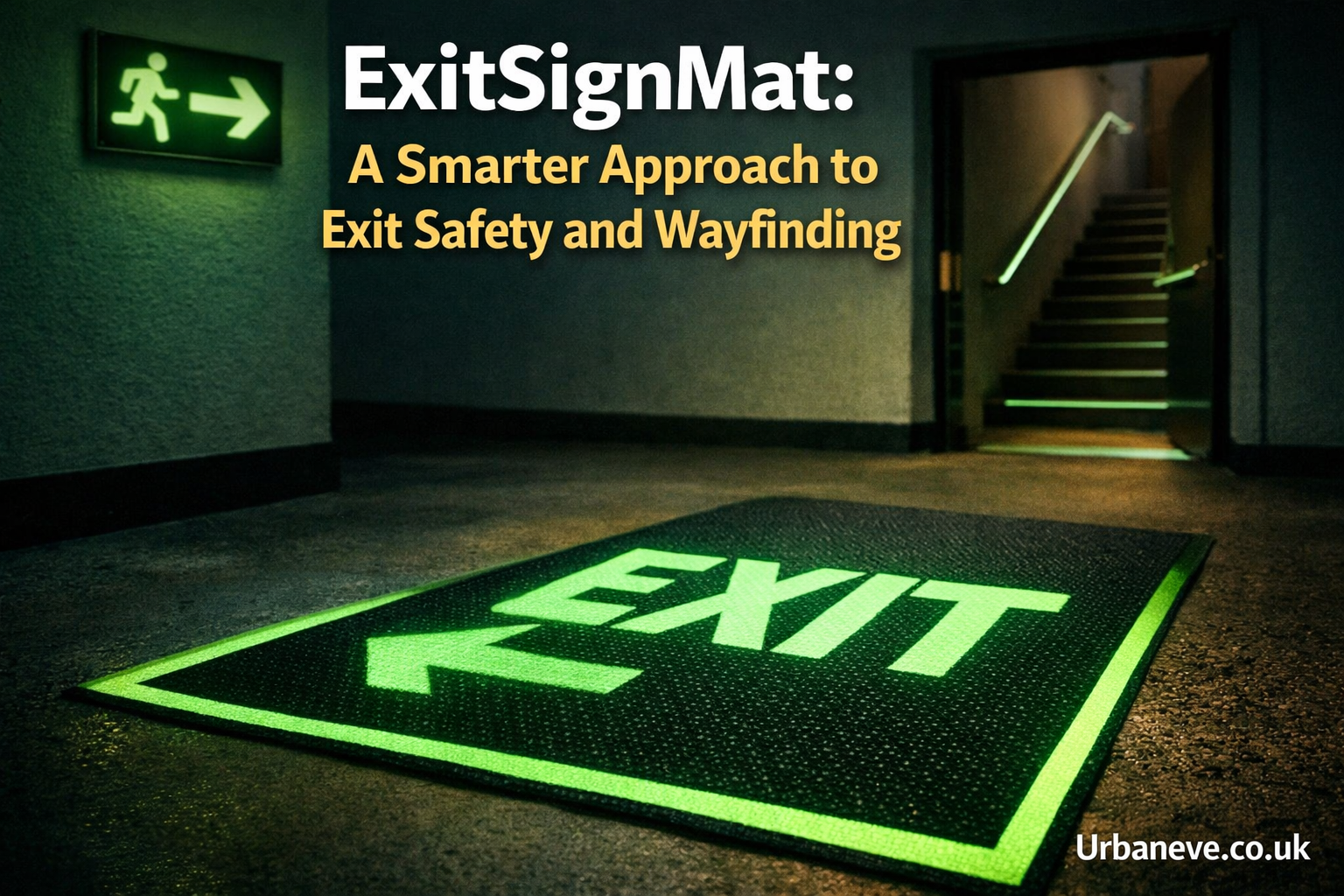
In an emergency, people do not behave like diagrams in a safety manual. They move quickly, follow instinct, and focus on what is directly in front of them. When visibility drops due to smoke, darkness, or power failure, traditional wall‑mounted exit signs can become harder to see at the exact moment they matter most. This is where ExitSignMat enters the conversation.
ExitSignMat refers to floor‑level exit guidance systems designed to support evacuation by guiding occupants along the safest route to an exit. Rather than replacing standard exit signage, ExitSignMat works as a complementary safety layer, helping people stay oriented when stress and reduced visibility make decision‑making difficult. As buildings become more complex and safety expectations rise, interest in floor‑based wayfinding continues to grow across commercial, residential, and public facilities.
Understanding What ExitSignMat Really Is
ExitSignMat is a general term used to describe high‑visibility floor markings or mats that indicate exit direction, exit proximity, or evacuation routes. These mats are placed directly on walking surfaces, typically along corridors, near stairwells, and in front of exit doors. The concept is based on a simple behavioral insight: during fast movement, people naturally look down to maintain balance and avoid obstacles.
Unlike traditional illuminated exit signs mounted above doors or high on walls, ExitSignMat stays within the occupant’s natural field of vision during movement. This positioning makes it especially effective in low‑visibility situations, where smoke rises and obscures overhead signage first. By reinforcing the exit path at floor level, ExitSignMat helps reduce hesitation, wrong turns, and congestion during evacuations.
Why Floor‑Level Exit Guidance Matters
Emergency evacuations are chaotic by nature. Even in buildings with well‑trained staff, unfamiliar occupants may struggle to find exits quickly. Studies in fire safety and human behavior consistently show that people rely heavily on environmental cues when under stress. Clear, continuous guidance can significantly influence how efficiently a crowd moves.
ExitSignMat supports this need by providing directional confirmation throughout the escape route. Instead of forcing occupants to scan walls or ceilings for information, the guidance appears where their attention already is. This can be particularly valuable in stairwells, long corridors, and multi‑level structures where visual continuity is essential.
Another important factor is confidence. When people feel unsure about where they are going, they slow down or stop. Floor‑level guidance helps maintain momentum, which is critical for preventing bottlenecks and reducing panic. In this way, ExitSignMat contributes not only to navigation but also to psychological reassurance during emergencies.
How ExitSignMat Fits Within Safety Codes and Standards
ExitSignMat is not intended to replace legally required exit signage or emergency lighting. Most building and workplace safety regulations still require illuminated exit signs and clearly defined exit routes. However, many codes recognize the value of supplemental wayfinding systems, particularly in high‑risk or high‑occupancy buildings.
In some jurisdictions, floor‑level or photoluminescent exit path markings are already required in specific settings, such as high‑rise stairwells. These regulations are based on lessons learned from real‑world emergencies, where traditional signage alone proved insufficient. Even where not mandated, authorities having jurisdiction often allow or encourage supplemental systems that enhance visibility and clarity without interfering with primary safety features.
The key is integration. ExitSignMat should work in harmony with existing signage, lighting, and evacuation planning. When installed correctly and maintained properly, it strengthens overall compliance rather than complicating it.
Materials and Design Considerations
ExitSignMat systems come in various forms, each designed to address different environmental needs. Some are made from durable, high‑contrast materials that remain visible under normal and emergency lighting. Others use photoluminescent technology, absorbing ambient light and emitting a visible glow when lighting conditions drop.
Material choice affects not only visibility but also durability and safety. Mats used in exit routes must be slip‑resistant, low‑profile, and securely fixed to prevent tripping hazards. Design clarity is equally important. Simple arrows, clear “EXIT” wording, and consistent direction indicators are far more effective than decorative or overly complex graphics.
Color contrast also plays a critical role. Effective ExitSignMat designs stand out clearly from the surrounding floor surface, ensuring they remain noticeable even in stressful conditions. Consistency throughout the building helps occupants quickly understand and trust the guidance being provided.
Where ExitSignMat Is Most Effective
ExitSignMat delivers the greatest value in buildings with complex layouts or large numbers of visitors. Hotels, hospitals, shopping centers, office towers, and educational campuses often have occupants who are unfamiliar with the building’s exit routes. Floor‑level guidance reduces reliance on memory or guesswork during an emergency.
Stairwells are another high‑impact location. In multi‑story buildings, stairwells serve as the primary means of egress, yet they can be disorienting under pressure. Clear floor‑level cues help people stay oriented and continue downward movement without hesitation.
Facilities that operate during nighttime hours or use reduced lighting for ambiance also benefit from ExitSignMat. In these environments, the transition from normal operations to emergency conditions can be abrupt, making supplemental guidance especially valuable.
Installation and Maintenance Realities
The effectiveness of ExitSignMat depends heavily on proper installation. Placement must be intentional, focusing on decision points such as corridor intersections, stair entrances, and exit approaches. Installing mats too late in the route or in cluttered areas reduces their impact.
Maintenance is equally important. Floor markings are subject to wear, cleaning chemicals, and foot traffic. Regular inspections ensure that the guidance remains visible, intact, and non‑slip. A faded or damaged ExitSignMat can undermine trust and create confusion, which is why ongoing care should be part of the safety management plan.
Documentation also matters. Keeping records of installation specifications and maintenance schedules supports accountability and demonstrates due diligence in the event of an inspection or incident review.
The Human Factor in Exit Design
At its core, ExitSignMat addresses a human reality: people under stress need simple, immediate information. They do not want to interpret complex instructions or search for signs when every second feels urgent. Floor‑level guidance meets this need with clarity and familiarity.
By aligning safety design with natural human behavior, ExitSignMat helps bridge the gap between theoretical compliance and real‑world performance. It acknowledges that effective evacuation is not just about meeting minimum requirements, but about anticipating how people actually move and react in emergencies.
Conclusion
ExitSignMat represents a thoughtful evolution in exit safety and wayfinding. It does not challenge the importance of traditional exit signs or emergency lighting, but instead reinforces them where they are most likely to fall short. By guiding occupants at floor level, ExitSignMat supports faster, more confident movement during emergencies, especially in low‑visibility conditions.
As building designs grow more complex and expectations around occupant safety continue to rise, supplemental systems like ExitSignMat are becoming less of a luxury and more of a practical consideration. When chosen carefully, installed correctly, and maintained consistently, ExitSignMat can play a meaningful role in protecting lives and improving evacuation outcomes. It is a reminder that good safety design starts with understanding people, not just regulations.