
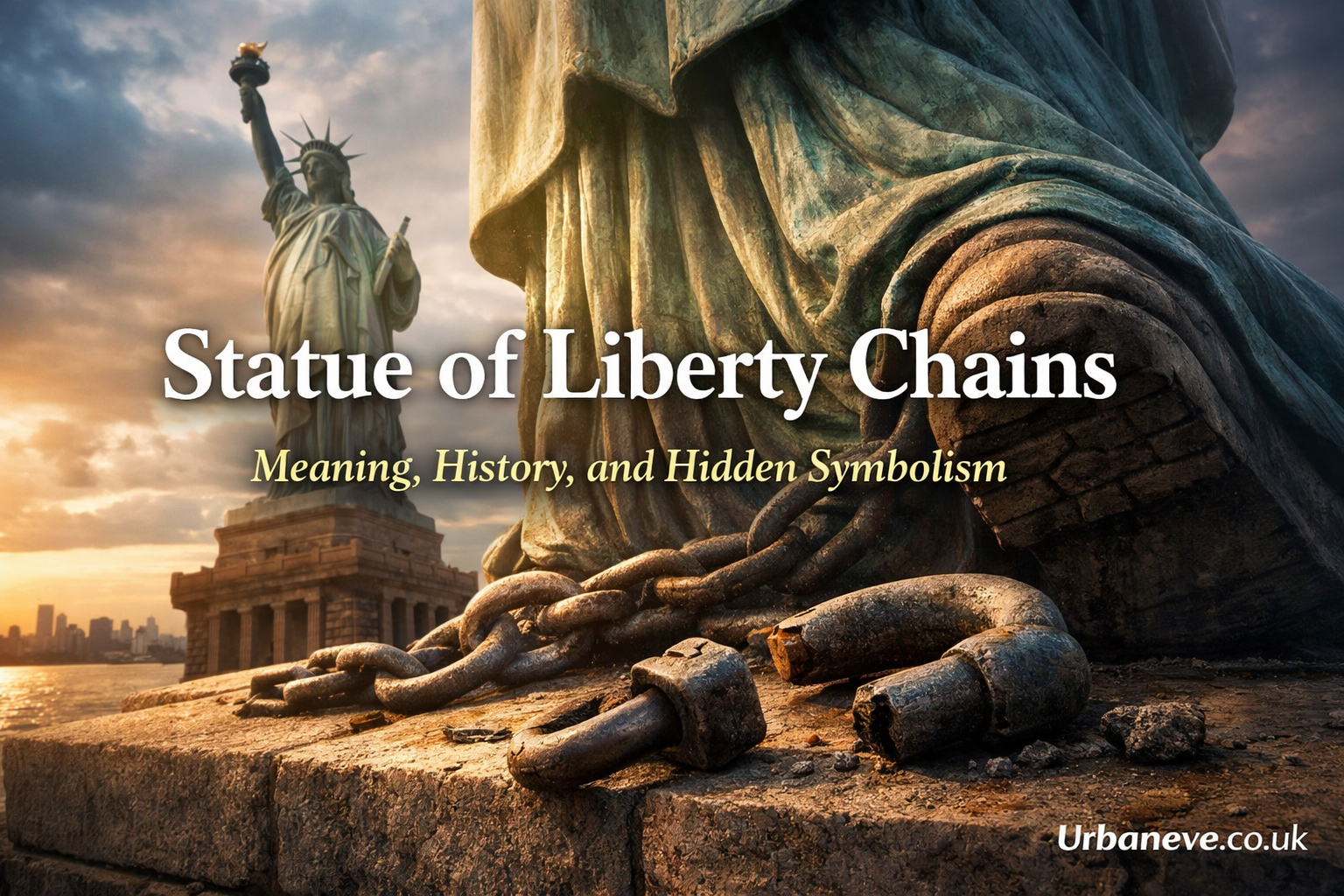
Millions of people travel to New York Harbor every year to see the Statue of Liberty. They look up at the torch, admire the crown, and photograph the tablet held firmly in her left arm. Yet very few notice what lies beneath the folds of her robe. Near her feet, partially hidden from view, are broken chains and shackles.
The Statue of Liberty chains are not a minor artistic flourish. They are one of the most powerful elements of the monument’s original message. Their quiet placement tells a story of liberation, unfinished freedom, and political compromise. Understanding this detail changes how the statue is seen—not just as a welcoming figure, but as a symbol rooted in struggle.
What Are the Statue of Liberty Chains?
The chains at the Statue of Liberty appear as a broken shackle and a severed chain link resting near her right foot. One end disappears beneath the drapery of her robe, while the other lies visibly broken. The statue is depicted stepping forward, as though she has just moved beyond the restraint that once held her.
These chains are permanent structural elements of the sculpture, not later additions. They were designed intentionally by the artist and cast as part of the original statue. Their placement at ground level makes them difficult to see from most angles, which is why so many visitors leave without ever realizing they are there.
The Original Meaning Behind the Chains
The Statue of Liberty was conceived in the late nineteenth century, a time when the United States was still grappling with the aftermath of the Civil War and the abolition of slavery. For many of the statue’s early supporters, liberty was not an abstract concept. It was a political and moral statement tied directly to the end of human bondage.
The broken chains symbolize liberation from oppression. In particular, they reflect the abolition of slavery and the broader idea of breaking free from tyranny. To audiences in the 1800s, chains were a widely recognized visual metaphor for enslavement. Their presence at Liberty’s feet would have been immediately understood as a declaration that freedom had replaced bondage.
Why the Chains Were Placed at Her Feet
Early design concepts for the Statue of Liberty included chains in a much more prominent position. The sculptor initially considered placing broken shackles in Liberty’s hands. That approach, however, was ultimately abandoned.
Moving the chains to her feet was a deliberate compromise. Placing them there allowed the message of liberation to remain part of the sculpture without making it politically confrontational for the era. By positioning the chains beneath her, the artist suggested that oppression had been overcome and left behind. At the same time, their partial concealment softened the statement for a divided public audience.
This choice explains why the chains feel like a hidden message today. They were never meant to dominate the visual experience, but they were never meant to disappear either.
A Symbol of Freedom That Was Not Yet Complete
When the Statue of Liberty was dedicated in 1886, freedom was still deeply unequal in the United States. Slavery had been abolished, but segregation, voter suppression, and racial violence were becoming entrenched realities for millions of African Americans.
The broken chains therefore represented hope more than accomplishment. They symbolized what liberty was supposed to mean, not what it fully was. This tension remains one of the most honest aspects of the statue. It reflects an ideal that the nation aspired to, even as it failed to live up to it.
This is why the chains continue to resonate. They acknowledge struggle rather than pretending it never existed.
How Immigration Changed the Statue’s Public Meaning
Over time, the Statue of Liberty became closely associated with immigration. As millions of newcomers passed through Ellis Island, the statue transformed into a symbol of refuge and opportunity. The focus shifted to the torch, the poem inscribed on the pedestal, and the promise of welcome.
As this new narrative took hold, earlier symbolism tied to abolition and broken chains faded from popular awareness. The statue’s meaning narrowed, even though its physical form did not change. The chains remained at her feet, quietly contradicting a purely celebratory reading of liberty.
This evolution shows how national symbols are shaped not only by their creators, but by how societies choose to remember them.
Why the Chains Matter Today
In the modern era, the Statue of Liberty chains have taken on renewed relevance. They are frequently discussed during moments of social protest, civil rights movements, and debates over who truly benefits from freedom in America.
The chains remind viewers that liberty is not passive. It requires the removal of barriers and the rejection of systems that limit human dignity. By showing liberty in motion—stepping away from broken restraints—the statue suggests that freedom is an ongoing process rather than a finished achievement.
This interpretation speaks directly to contemporary audiences who understand that rights can expand or contract depending on political choices.
Why So Many People Still Miss the Chains
There are practical reasons the Statue of Liberty chains are overlooked. The monument’s immense scale draws the eye upward. From ground level, the folds of the robe obscure the feet. Photographs, souvenirs, and media representations rarely highlight this area.
But there is also a cultural reason. Societies tend to emphasize comforting narratives over challenging ones. The image of liberty as a welcoming figure is easier to embrace than the reminder that freedom must be fought for and protected.
The chains disrupt simplicity, and disruption is often ignored unless deliberately examined.
Conclusion
The Statue of Liberty chains are a quiet but powerful reminder of what liberty truly demands. They represent the breaking of oppression, the hope of equality, and the reality that freedom is never fully guaranteed. Hidden at her feet, they ask viewers to look closer and think deeper.
By understanding the chains, the statue becomes more than a landmark or a postcard image. It becomes a reflection of a nation still defining what liberty means and who it is meant to serve. In that sense, the broken shackles are not relics of the past. They are symbols of a promise that remains unfinished—and therefore still worth pursuing.